
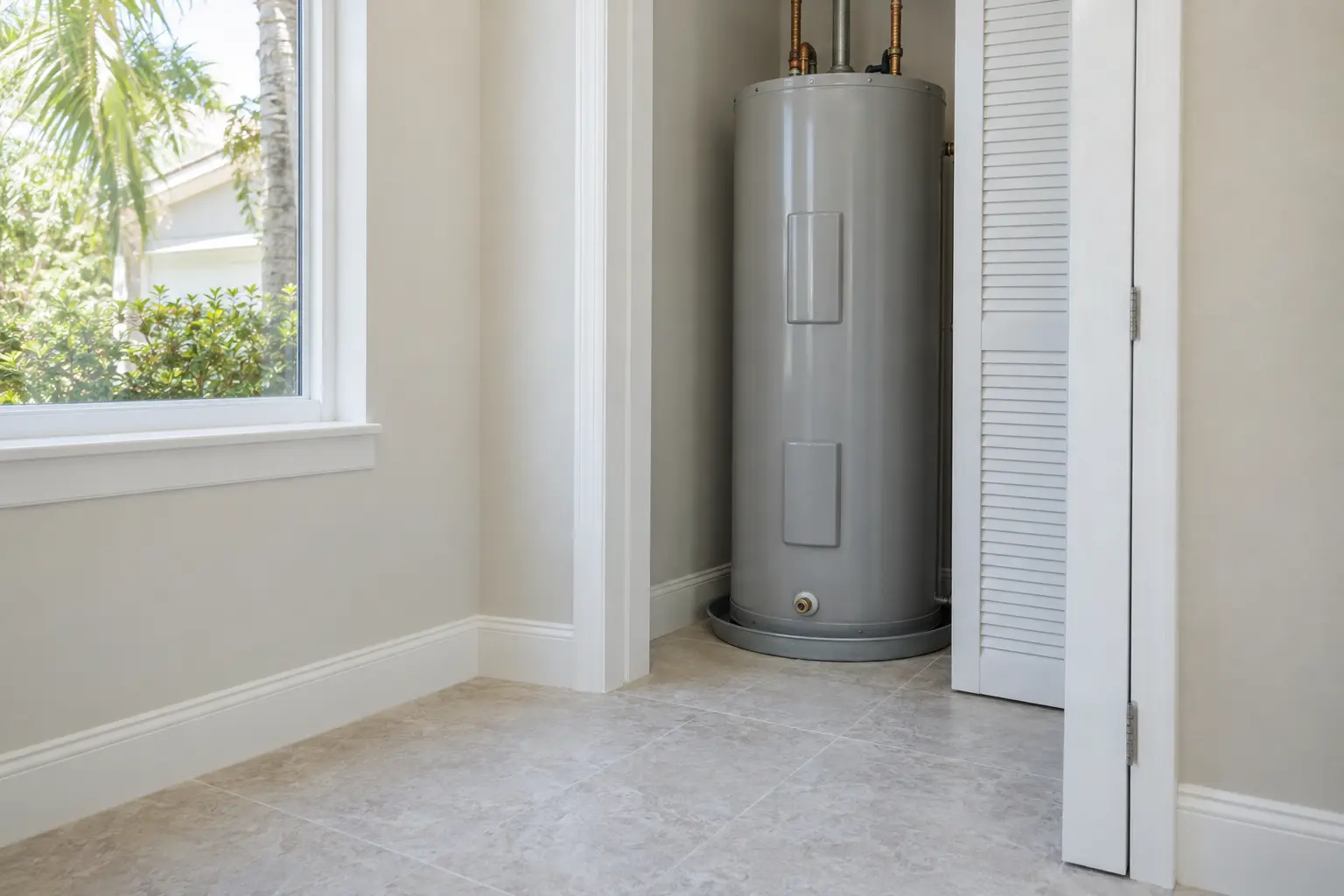
TL;DR: Water damage from a water heater leak usually spreads farther than the puddle you can see. Water runs under baseboards, up drywall and under floating floors. Shut off the water and power, have a plumber handle the tank, document everything, and get the structure dried within 24 to 48 hours to keep mold from starting.
Water damage from a water heater leak almost always reaches farther than the puddle you can see. Water runs under baseboards, wicks up drywall and seeps under flooring. What happens next: shut off the water and power, have a plumber deal with the tank, then get the house extracted and dried within 24 to 48 hours.
Finding a wet floor around the tank is stressful, especially at night or on a holiday weekend. The good news is that most water heater leaks start as clean water, and clean water caught early can often be dried in place. Here is what to expect in a Central Florida home.
How much water can a leaking water heater release?
A failed tank can flood several rooms in minutes, and a slow leak can go on for weeks before anyone notices. The U.S. Department of Energy says a home storage water heater holds 20 to 80 gallons. If the tank fails and the cold supply keeps feeding it, water keeps coming until someone closes a valve.
In Groveland and across Central Florida, most homes are built slab-on-grade with drywall walls. That matters. Water spreads across the slab, slips under baseboards and wicks up the drywall from the bottom. It also gets under laminate and vinyl plank, where you cannot see it. The tank might sit in a Groveland garage or a hall closet in a Poinciana home. Either way, the rooms that share a wall with it are usually the first to get wet.
What should you do in the first hour after a water heater leak?
Stop the water, cut the power or gas, and take photos before anything gets moved. Most homeowners can safely do these steps:
- Close the cold water valve on the pipe going into the top of the tank. If you can’t find it or it won’t turn, close the main shutoff to the house.
- Turn off the energy source. For an electric heater, switch off its breaker. For a gas heater, turn the gas control to off. Never stand in water to reach an outlet or panel.
- Take photos and video of the tank, the floor and any wet walls. Your insurance carrier will want them.
- Move rugs, boxes and furniture off wet flooring. Put foil or blocks under furniture legs that have to stay.
- Call a plumber about the tank and a water damage restoration company about the house. These are two different jobs.
If water is coming from the pipe on the side of the tank, the likely source is the temperature and pressure relief (TPR) valve. InterNACHI, the home inspector association, explains that this valve releases water when temperature or pressure in the tank gets too high. It also says a leaking TPR valve usually needs to be replaced. That is plumber work. EnviroTech Solutions does not repair or replace water heaters. We handle the water that got out.
Slow drip or sudden burst: how does the type of leak change the job?
The type of leak decides how far the water traveled and how long it sat. Those two things decide what has to come out. Here is how common water heater failures usually compare.
| Type of leak | How it usually shows up | What usually gets wet | Typical restoration scope |
|---|---|---|---|
| TPR valve drip or discharge | Water at the discharge pipe or on the floor by the tank | Floor around the tank, nearby baseboards | Often extraction and drying in place if caught quickly |
| Drain valve drip | Small puddle at the base, sometimes for weeks | Slab under the tank, bottom of nearby walls | Moisture readings behind walls; baseboards may come off |
| Fitting or supply line leak at the top | Wet tank jacket, water running down the side | Floor, closet walls, nearby cabinets | Often dried in place; walls and cabinet bases checked |
| Rusted tank seeping | Rust stains, slow seep, musty smell | Drywall, baseboards and flooring that stayed wet a long time | More material removal; check for mold |
| Tank burst | Sudden flooding across several rooms | Flooring, drywall, cabinets and contents in multiple rooms | Emergency extraction, flood cuts, several days of drying |
Time is the biggest factor. The EPA says that if wet materials are dried within 24 to 48 hours, mold will not grow in most cases. Our heat and humidity can let mold start inside that same window. That is why a slow seep behind a closet wall often turns into more work than a burst someone caught right away.
What has to come out, and what can be dried in place?
Materials that hold water and can’t be dried to a dry standard come out. The slab, framing and many walls can usually be dried in place. On a typical clean-water job, it plays out like this:
- Baseboards usually come off so air can reach the bottom of the wall.
- Soaked or swollen drywall is cut out a short distance above the wet line. Drywall that is only damp can often be dried through small holes drilled behind the baseboard.
- Carpet pad is usually thrown out. Carpet can sometimes be saved if the water was clean and it was handled fast.
- Laminate and some vinyl plank trap water underneath and often have to be lifted.
- Cabinet toe kicks may come off so the space under the cabinets can dry.
After tear-out, technicians set commercial dehumidifiers and air movers. They take moisture readings every day until materials reach a dry standard. For the full sequence, see our guide to the water damage restoration process, step by step. For drying times, see how long water damage restoration takes in Central Florida. Once everything is dry, your contractor handles the rebuild.
Signs the water spread farther than you think
- Baseboards or door trim that are swollen, soft or pulling away from the wall
- Bubbling paint or a dark line low on a wall in the room next to the tank
- Laminate or vinyl plank that feels spongy, cups or clicks underfoot
- A musty smell a day or two after the floor looks dry
- In a condo or townhome, stains on the ceiling or walls of the unit below
Any one of these means water is inside the wall or under the floor. Moisture meters and thermal imaging show where it went, so no one has to open walls blindly.
Does homeowners insurance cover water heater leak damage?
Many policies cover water damage from a sudden leak, but how a claim is handled depends on your policy. A sudden burst is often treated differently from a slow leak that went on for weeks. The tank itself may be handled differently from the damage it caused. Your adjuster makes the call based on your policy language. Before you call, read our breakdown of whether homeowners insurance covers water damage in Florida. Every claim goes better with photos from the first hour, the plumber’s note on what failed, and daily drying records that show why the work was needed.
Why homeowners call EnviroTech Solutions for water heater leaks
- We are family-owned and operated, with one office at 15380 County Road 565A in Groveland.
- We answer 24 hours a day, 7 days a week, holidays included.
- Our technicians are IICRC-certified, and the company is licensed and insured.
- We use moisture meters and thermal imaging, and we take daily moisture readings until the structure is dry.
- If a long-running leak has already caused mold, we hold Florida mold remediation license MRSR4759.
- We work with all major insurance companies and document the job for the claim.
- We hold a 5.0-star rating from 41 Google reviews.
Water heater failures are a regular call for us. After her water heater burst on Memorial Day weekend, Cari wrote in her review: “He answered immediately and was on site within the hour.” That was one job, not a promised arrival time, but it shows how we handle these calls.
If your water heater leaked, call EnviroTech Solutions at 321-758-9787, day or night, or book a water damage estimate online.
Frequently Asked Questions
Can I keep using my water heater after it leaks?
Leave the water and power or gas off until a plumber checks it. If the tank itself is leaking, it can’t be fixed and has to be replaced. A leaking valve or fitting can often be repaired.
Is water from a water heater considered clean water?
It usually starts as clean water because it comes from your supply line. Once it sits on floors and soaks into building materials, it picks up dirt and bacteria. That is why fast extraction and drying matter, even for a clean-water leak.
Will household fans dry out a water heater leak?
Fans can dry the surface, but they don’t pull moisture out of the air or out of the drywall, slab and cabinets. Without dehumidifiers and moisture readings, a floor can look dry while the wall behind it stays wet enough to grow mold.
How can I lower the chance of another water heater leak?
The U.S. Department of Energy recommends flushing a quart of water from a storage tank every three months to help with sediment. Have a plumber check the relief valve and the tank’s condition, especially on an older unit.
Recommended Reads
- What Is the Water Damage Restoration Process, Step by Step?
- How Long Does Water Damage Restoration Take in Central Florida?
- What Drives Water Damage Restoration Cost in Florida Homes?